

November 9, 2026

A heavy main gate is not always easy to operate. For some homeowners, opening it means getting out of the car, moving the gate...
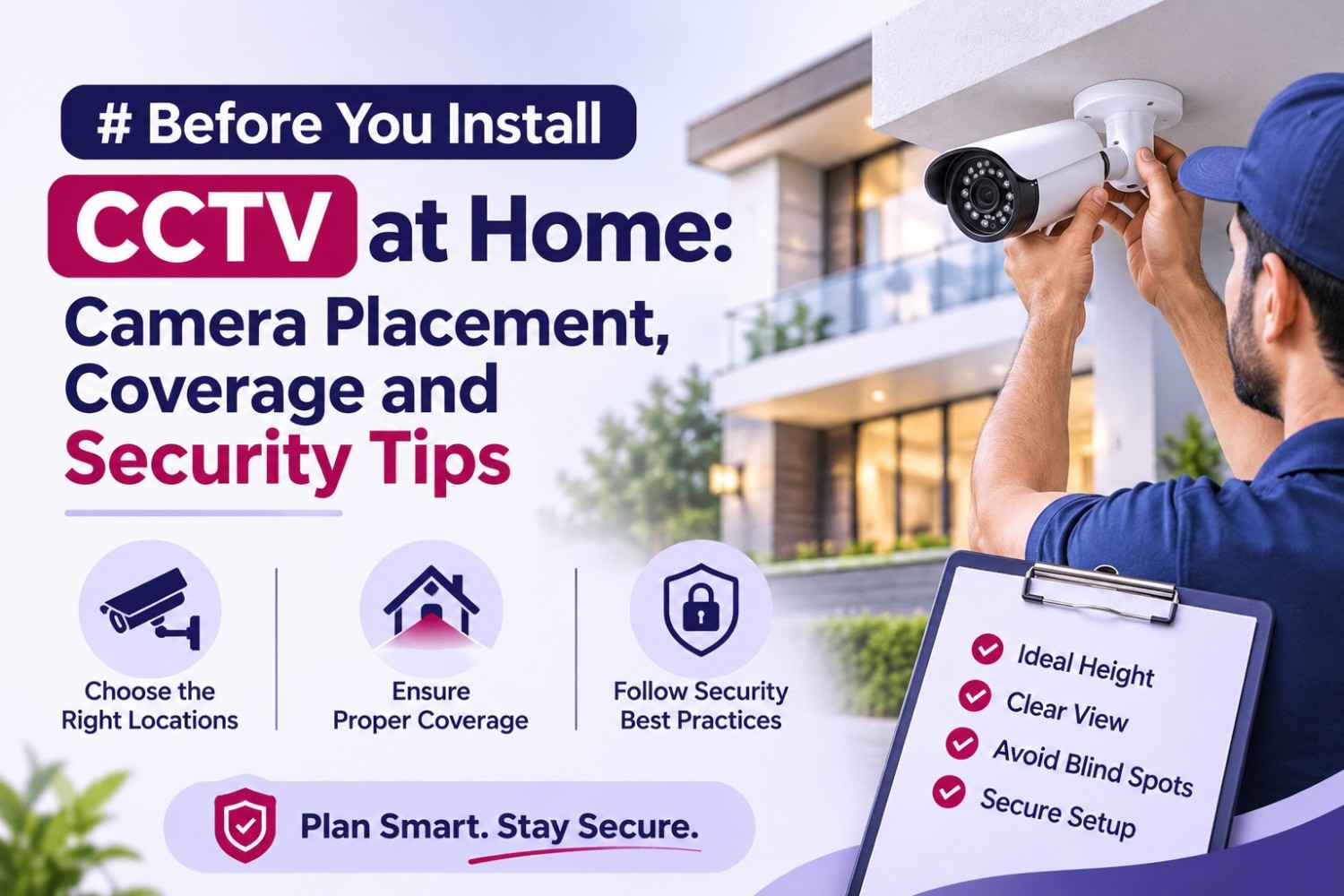
Imagine installing four CCTV cameras around your house, only to discover later that the main entrance is not clearly visible in the footage. The parking area has a blind spot, the backyard camera cannot capture faces properly at night, and the recording system has already run out of storage.
This happens more often than homeowners realise. Buying good-quality cameras does not automatically mean your property is properly protected. Their placement, viewing angle, recording quality and storage configuration are equally important.
A well-planned home CCTV installation should begin with understanding which areas need monitoring and what you expect the system to capture. Whether you live in an independent house, apartment or villa, the objective is to create useful camera coverage without installing unnecessary equipment.
If you are considering CCTV installation in Hyderabad, here are the important things to understand before choosing cameras and planning their installation.
A home security camera system helps property owners monitor important areas and review recorded footage when required.
It can be particularly useful for:
However, CCTV should be considered one part of a broader security plan. Proper locks, adequate outdoor lighting, secure doors and windows, and responsible access management also matter.
According to the US Cybersecurity and Infrastructure Security Agency (CISA), protecting a home involves considering multiple physical security measures rather than depending on a single solution.
One of the biggest mistakes homeowners make is deciding the number of cameras before identifying the areas that require monitoring.
Instead, walk around your property and identify the entrances, outdoor spaces and vulnerable locations that need visibility.
The main entrance should be one of the first locations to consider.
It is where visitors, delivery personnel and other individuals enter your property. A properly positioned camera can help record activity around the entrance.
Consider a camera that:
Avoid positioning the camera so high or at such an extreme angle that it only records the tops of people’s heads.
Vehicle parking areas are another important location for CCTV coverage.
Whether you have an independent driveway, covered parking or a shared residential parking space, monitoring this area can help you review vehicle movement and unusual activity.
For effective coverage, consider:
For larger parking spaces, more than one camera may be required depending on the layout.
Homeowners sometimes focus entirely on the front entrance and overlook the rear side of their property.
Back doors, garden entrances, utility areas and other less visible locations may also require monitoring.
A suitable outdoor camera should be selected according to its exposure to rain, dust, sunlight and other environmental conditions.
Side passages and boundary areas can create blind spots, especially in independent houses and villas.
Cameras positioned strategically around these locations can help monitor movement along the property’s exterior.
However, the objective should be to cover your own property as much as reasonably necessary. Avoid unnecessarily recording neighbouring homes or private spaces.
In multi-storey houses and residential buildings, staircases and common access areas may require additional monitoring.
For apartment complexes, camera placement should be planned according to shared spaces, building access points and the requirements of the association.
Cameras should not be installed in locations where people reasonably expect privacy.
Garages and outdoor utility spaces often contain vehicles, tools, equipment and other valuable belongings.
Depending on the layout, a camera covering the garage entrance or storage area may be useful.
Choose a camera with suitable resolution and lighting performance so that important details remain visible.
If your property has an accessible terrace, external staircase or rooftop entrance, consider whether these locations need monitoring.
Camera selection should account for weather exposure, mounting arrangements and available lighting.
The important thing is not to install cameras everywhere, but to identify the areas where monitoring provides genuine value.
Not every CCTV camera is designed for the same environment. The right choice depends on where it will be installed and what you want to monitor.
Here are some common camera types.
Dome cameras are commonly used in indoor spaces and covered areas.
Their compact design makes them suitable for locations such as entrances, corridors, reception areas and certain commercial environments.
Bullet cameras are often used for outdoor monitoring.
They are suitable for locations where a particular direction or area needs to be monitored, such as driveways, boundary walls and building entrances.
PTZ stands for Pan, Tilt and Zoom.
These cameras allow the viewing direction and zoom to be adjusted remotely, depending on the model and configuration.
They may be useful for larger properties or locations where flexible monitoring is required.
IP cameras transmit video over a network and can support remote viewing through compatible applications and recording systems.
They are often considered for modern CCTV installations where network connectivity, video quality and system expansion are important.
The camera type should be selected according to the installation environment, coverage requirements and available infrastructure.
Camera specifications can look impressive on paper, but not every feature will be equally useful for your property.
Before finalising a CCTV camera installation, pay attention to the following.
Feature | Why it matters |
Resolution | Helps capture clearer video details |
Night vision | Supports monitoring in low-light conditions |
Field of view | Determines how much area the camera can cover |
Motion detection | Helps identify activity in selected areas |
Weather resistance | Important for outdoor installations |
Remote viewing | Allows access to footage through compatible devices |
Storage capacity | Determines how much recorded footage can be retained |
Mobile notifications | Can alert users to selected activities |
For example, a camera with high resolution may still produce poor footage if it is facing direct light or installed at an unsuitable angle.
Similarly, a camera with night vision needs appropriate positioning and lighting to capture useful footage.
Choosing cameras is only one part of a CCTV installation. You also need a suitable recording and storage arrangement.
Two common options are DVR and NVR systems.
A DVR is generally used with compatible analogue CCTV cameras.
Video is transmitted to the recorder through the required cabling arrangement, where footage is processed and stored.
DVR systems can be considered for properties looking for a conventional wired CCTV setup.
An NVR is designed for compatible network cameras, commonly IP cameras.
Video is transmitted over a network, and the recorder manages the recording and storage process.
NVR systems can offer flexibility when planning network-based camera installations.
Factor | DVR | NVR |
Camera type | Compatible analogue cameras | Compatible network/IP cameras |
Video transmission | Typically coaxial cable | Network connection |
System design | Conventional CCTV setup | Network-based setup |
Expansion | Depends on recorder capacity | Depends on network and recorder capacity |
Installation | Requires suitable cabling | Requires suitable network planning |
The right option depends on the number of cameras, property layout, existing wiring, storage requirements and future expansion plans.
Even a good camera system may not provide useful footage if the installation is poorly planned.
Here are some mistakes worth avoiding.
Buying cameras first and deciding their positions later can result in overlapping footage in some areas and blind spots in others.
Start by identifying the areas you need to monitor.
A camera that performs well during daylight may not provide the same clarity after sunset.
Check night-time image quality and consider whether additional lighting is needed.
A lower-priced camera may not provide the resolution, durability or features required for your installation.
Compare the complete specifications and suitability rather than looking at the purchase price alone.
Recording continuously can consume considerable storage space.
Choose a recording configuration according to the number of cameras, video quality, recording schedule and required retention period.
Connected cameras and recording systems should be protected against unauthorised access.
Use strong passwords, update device firmware and restrict access to authorised users.
Dust, insects, rain and changing outdoor conditions can affect camera performance.
Periodically inspect camera lenses, mounting arrangements, recording status and storage availability.
CCTV cameras should be installed responsibly.
A homeowner may want to monitor an entrance or driveway, but the camera’s viewing angle should not unnecessarily capture neighbouring properties or private spaces.
Also consider who can access the recordings, how long footage is retained and whether remote viewing accounts are properly secured.
The UK Information Commissioner’s Office provides useful guidance on using CCTV systems on domestic properties.
For Indian CCTV equipment, it is also worth reviewing the Government of India’s Ministry of Home Affairs CCTV guidelines.
These resources highlight why camera positioning, recording management and system security should be considered alongside installation.
Consider a house with four outdoor cameras. One covers the main gate, another monitors the driveway, and the remaining two are positioned near the backyard and side entrance.
At first glance, this may appear sufficient. But if the cameras have unsuitable viewing angles, poor lighting conditions or overlapping coverage, important activity may still go unnoticed.
This is where professional planning becomes useful.
A proper CCTV installation process should include:
If you are planning a new installation or upgrading an existing system, explore Kuvera International’s CCTV Surveillance Services.
Finding a suitable CCTV installation provider requires more than comparing quotations.
Before selecting a company, consider these questions:
Does the company inspect the property?
A site inspection helps determine the number of cameras, their locations and the required equipment.
Do they recommend cameras according to the application?
Indoor cameras, outdoor cameras and parking-area cameras may have different requirements.
Do they explain the recording system?
You should understand whether the proposed setup uses DVR or NVR, how much storage is available and how long footage can be retained.
Do they configure remote access securely?
Ask about authorised users, password protection and device updates.
Do they provide after-installation support?
Understand the warranty, maintenance arrangements and technical assistance available if the system develops a problem.
A reliable installation should be planned around the property’s security requirements rather than simply increasing the number of cameras.
Installing CCTV cameras is not just about placing devices around your property. Their effectiveness depends on where they are positioned, what they capture, how recordings are stored and how securely the system is managed.
If you are considering home CCTV installation, start by identifying the areas that need monitoring. Pay attention to entrances, driveways, boundary areas and other vulnerable locations. Then select suitable cameras, plan the recording system and ensure that the installation is carried out correctly.
For homeowners and businesses looking for CCTV installation in Hyderabad, a properly planned surveillance system can become a valuable part of a broader security arrangement.
Explore Kuvera International’s CCTV Surveillance Services to discuss your property requirements and available installation options.
The number depends on the property’s size, layout, entrances and monitoring requirements. A smaller house may need fewer cameras, while a larger villa may require additional coverage for parking, boundary walls and outdoor spaces.
Common locations include the main entrance, driveway, parking area, backyard, side passages and other accessible outdoor areas. Camera positions should be planned to minimise blind spots.
Outdoor cameras should be selected according to weather exposure, required viewing distance, lighting conditions, resolution and mounting location. Bullet and suitable dome cameras are commonly considered for outdoor applications.
DVR systems generally work with compatible analogue cameras, while NVR systems are designed for network-based IP cameras. The choice depends on the camera setup, wiring and recording requirements.
Yes. Compatible CCTV systems can support remote viewing through mobile applications. This generally requires suitable network connectivity and secure account configuration.
Storage duration depends on the hard drive capacity, number of cameras, recording resolution, frame rate and recording schedule. The required retention period should be decided before selecting the storage system.
Professional installation can help with camera positioning, cable management, recording configuration, network security and system testing. It is particularly useful for larger properties and multi-camera setups.
A heavy main gate is not always easy to operate. For some homeowners, opening it means getting out of the car, moving the gate...

An automatic gate makes everyday entry and exit more convenient while adding an extra layer of security to your property. Whether you own an...
Fire safety is one of the most critical aspects of protecting people, property, and business operations. A reliable fire alarm system provides early detection...